Gorillaz made an album with six dead people. Only a cartoon band could pull that off.
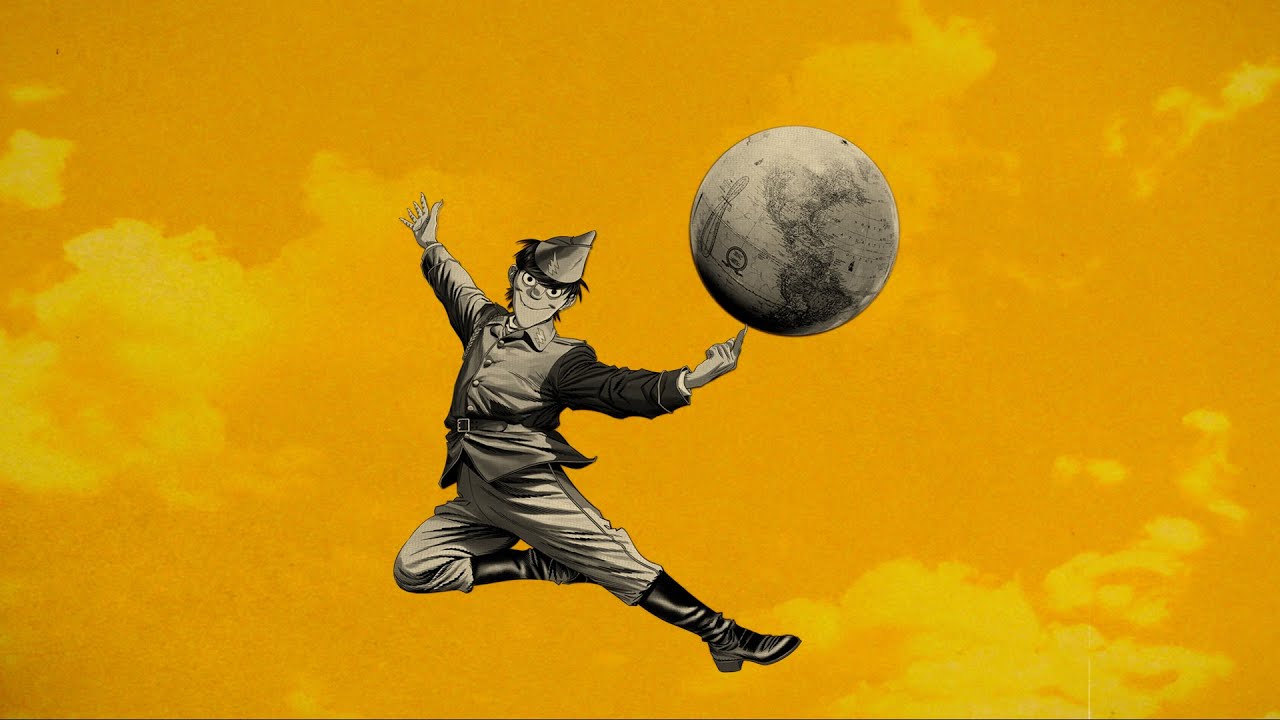
Six of the collaborators on The Mountain are dead. Dennis Hopper. Bobby Womack. David Jolicoeur of De La Soul. Tony Allen. Proof from D12. Mark E. Smith of The Fall. Their voices appear on the new Gorillaz album not as AI reconstructions or archive-scraped samples, but as real recordings Damon Albarn made with them over the past twenty years. Material that sat in a vault, waiting for the right context.
The right context turned out to be a concept album about mortality.
Both Albarn and Jamie Hewlett lost close family members before starting work on The Mountain. The album's press materials describe it as "a playlist for a party on the border between this world and whatever happens next." When I first read that line, it sounded like marketing. After hearing the singles and understanding the tracklist, it reads more like a literal description.
Bobby Womack sings on "The Moon Cave" alongside living artists Jalen Ngonda and Black Thought. Tony Allen, the Afrobeat drummer who died in 2020, plays on "The Hardest Thing." Mark E. Smith, dead since 2018, shows up on "Delirium." These tracks don't feel like tributes or memorials. The dead musicians aren't cordoned off into special "featuring the late..." moments. They're just there, performing alongside people who are still alive, as if the distinction doesn't matter.
And here's the thing: for Gorillaz, it kind of doesn't.
The only band where nobody is real
Gorillaz have been fictional since day one. 2D, Murdoc, Noodle, Russel — cartoon characters voiced and animated by Hewlett while Albarn and whoever he's collaborating with make the actual music. For the first decade, this felt like a gimmick, a clever visual wrapper for what was essentially Albarn's solo project with famous friends.
But twenty-five years in, the format has become something stranger. When everyone in the band is already a fiction, the question of who's alive and who's dead gets genuinely blurry. A cartoon bassist and a dead rapper exist in the same ontological space: neither is physically present, both are sonically real. The Mountain leans into that ambiguity harder than any previous Gorillaz record.
Consider how bizarre this would be for a conventional band. If Coldplay released an album featuring vocals from a musician who died fifteen years ago, it would be framed as a posthumous event — a special, weighted thing. Press releases would handle it delicately. Listeners would approach those tracks differently. But Gorillaz have always asked you to accept that the "real" performers are invisible, hidden behind animated surrogates. Adding dead collaborators to that mix doesn't require a conceptual leap. It just extends the logic that was already there.
Recordings, not resurrections
What makes this work — and what separates it from the growing wave of AI-generated posthumous music — is that these are actual recordings. Albarn sat in a room with Dennis Hopper. He played alongside Tony Allen. He worked with Bobby Womack on multiple Gorillaz records before Womack died in 2014. The performances on The Mountain are not synthetic reproductions. They are artifacts of real human interaction, stored on tape, now placed into new arrangements.
"Damascus," the fourth single featuring Omar Souleyman and Yasiin Bey, was originally recorded for Plastic Beach"Damascus," the fourth single featuring Omar Souleyman and Yasiin Bey, was originally recorded for Plastic Beach around 2009-2010 under the title "Fresh Arrivals." It was cut in favor of "Sweepstakes." Sixteen years later, it finally gets a release. The dabke rhythms give it an energy unlike anything else in the Gorillaz catalog, and there's something moving about a recording from pre-civil-war Syria emerging now, in 2026, as if time has folded in on itself.
This is what vaults are for. Not the exploitative posthumous cash-grabs that plague hip-hop and pop — the XXXTentacion albums assembled from scraps, the Juice WRLD records stretched past coherence. Albarn had complete, finished recordings with artists who happened to die before he found the right album for them. The Mountain is that album, and the mortality theme makes every posthumous contribution feel intentional rather than opportunistic.
A concept album that earns it
The Mountain drops February 27, 2026. Fifteen tracks, recorded across Turkmenistan, India, Damascus, and Miami. The living collaborators are equally far-flung: Anoushka Shankar plays sitar on five tracks, Johnny Marr of The Smiths appears on four, Black Thought shows up on three. Argentine rapper Trueno, post-punk band IDLES, Bollywood legend Asha Bhosle. The guest list could easily overwhelm the album the way it did on Humanz in 2017, where the features felt like the point rather than the means.
Early reviews suggest this time is different. Record Collector gave it four out of five stars, calling it "a record of sorrows, salves and state-of-the-now despair." The difference might be the concept. Grief and the afterlife give every collaboration a reason to exist beyond "wouldn't it be cool if." When Asha Bhosle sings on "The Shadowy Light," it carries the weight of a 93-year-old voice on an album explicitly about the threshold between life and death. When Proof, killed in a nightclub shooting in 2006, raps on the same record, that threshold collapses.
The lead single "The Happy Dictator," featuring Sparks, channels Turkmen dictator Saparmurat Niyazov, who literally banned bad news and demanded citizens think only positive thoughts. On an album haunted by real death, a song about forced happiness lands differently than it would as a standalone quirk.
Virtual bands in 2026
It's worth noting that this is the first Gorillaz album released independently — on their own Kong label, distributed through Sony's The Orchard, free of Parlophone and Warner for the first time since 2001. That matters less for the music than for what it says about where Albarn and Hewlett see the project: not as a legacy act managed by a major, but as something they still control and still want to push somewhere weird.
The virtual band concept, which felt fresh in 2001 and played-out by 2017, now exists alongside K-pop acts like PLAVE — fully virtual idols charting on real music shows — and AI artists generating music without any human involvement at all. Gorillaz sit in an odd middle ground: fictional characters making real music with real (and sometimes dead) people. That middle ground turns out to be the most interesting space.
Because the question The Mountain really asks is: when does a recording stop being a live performance and start being a ghost? If Bobby Womack's voice was captured on tape in 2012, and that tape is pressed into vinyl in 2026, is he performing on the album? Is he less present than Anoushka Shankar, who presumably recorded her sitar parts recently but whose contributions are equally mediated by studio technology?
Gorillaz have been accidentally preparing for this question for twenty-five years. A band where nobody is physically real is the perfect vehicle for an album where some of the performers are physically gone. The Mountain doesn't resolve that tension. It just turns it into music, and asks you to dance at the party on the border.